
The History of Earth – From the Big Bang to the Last Light, We Are Just Guests
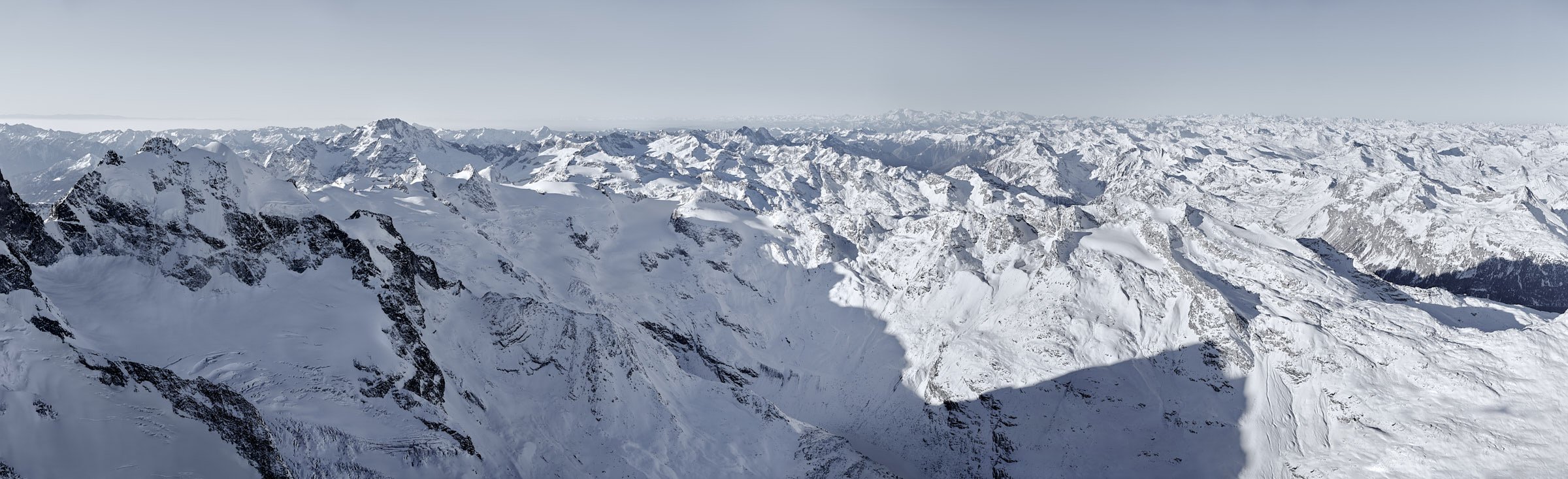
View of the Alps from Piz Bernina Photo © Jürg Kaufmann
The Earth has existed for 4,560,000,000 years. Homo sapiens for about 300,000 years. That is 0.0066 percent of Earth’s history. If the Earth were a 100-meter swimming pool, the entire history of humanity would occupy the last 6.6 millimeters. The Holocene—those 11,700 years during which we invented agriculture, built cities, and established civilizations? A quarter of a millimeter. Invisible without a magnifying glass.
Humanity likes to put itself at the center of everything. But in reality, we are merely guests here, and our stay is much shorter than we imagine. This article tells the story of our host: a story of massive upheavals, from a glowing ball of rock to a planet that has been almost completely buried under ice on multiple occasions. With a special focus on the glaciers and ice ages that have repeatedly and fundamentally altered the face of the Earth. And with a foreseeable end, for in about five billion years, the Sun will engulf our planet.
Note: This article was compiled and verified using AI. The volume of underlying data and facts is substantial. The goal is to use this information to describe a clear timeline of Earth’s history. Despite the considerable effort involved, we cannot guarantee 100% accuracy.
Before Earth: The Big Bang
Nano Banana Pro: A Promt by Jürg Kaufmann
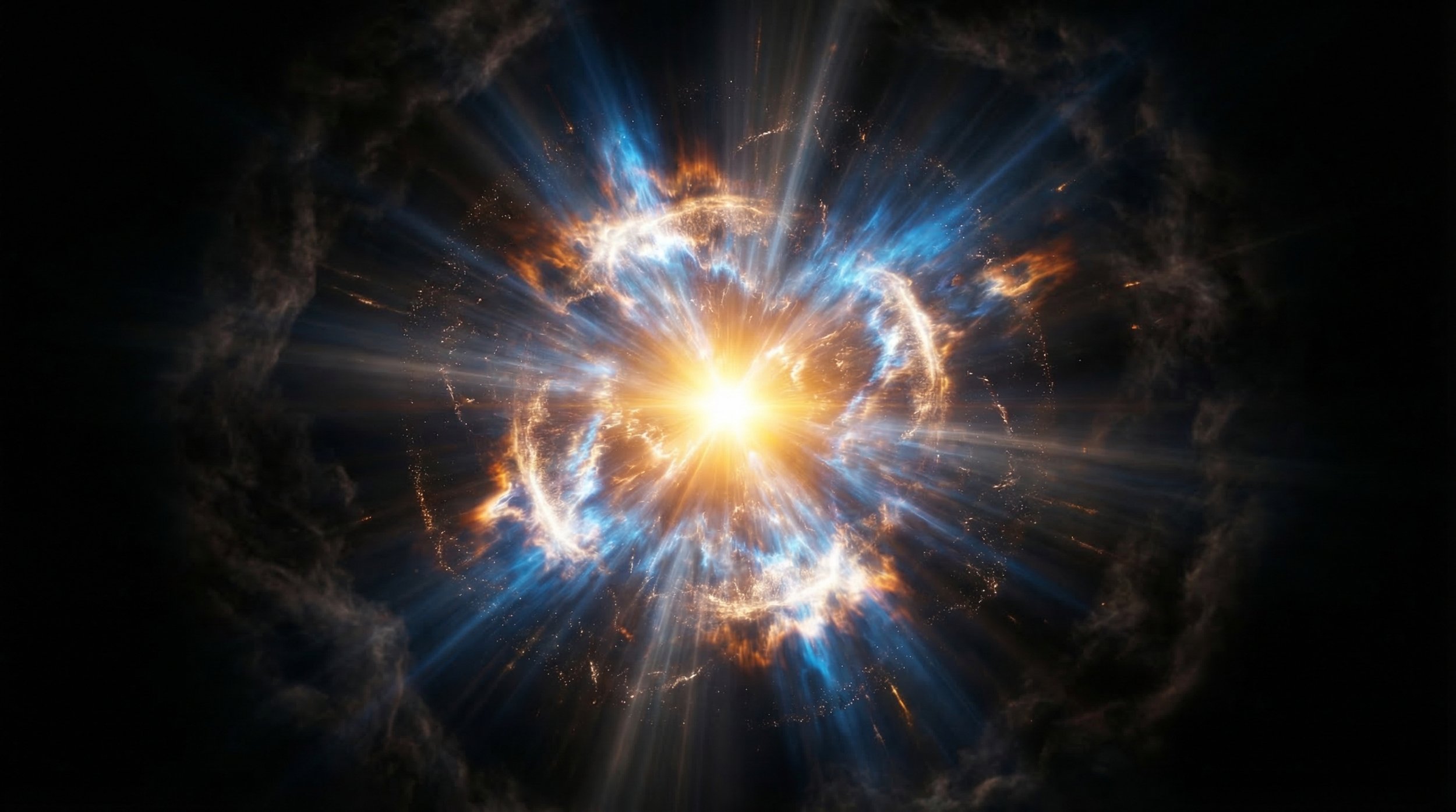
About 13.8 billion years ago, the universe expanded abruptly from an unimaginably hot and dense state. Within the first few minutes, the lightest elements formed: hydrogen and helium. After about 380,000 years, the universe had cooled enough for atoms to form—it became transparent to light for the first time. Today, we measure this ancient light as cosmic background radiation.
Over billions of years, gas clouds condensed into stars and galaxies. In the nuclear furnaces of these stars, heavier elements were forged—carbon, oxygen, iron. Exploding stars scattered these building blocks throughout space. The Earth and everything on it is, quite literally, made of stardust.
The Hadean Eon: A World of Fire (4.56 billion years ago)
Nano Banana Pro: A Promt by Jürg Kaufmann
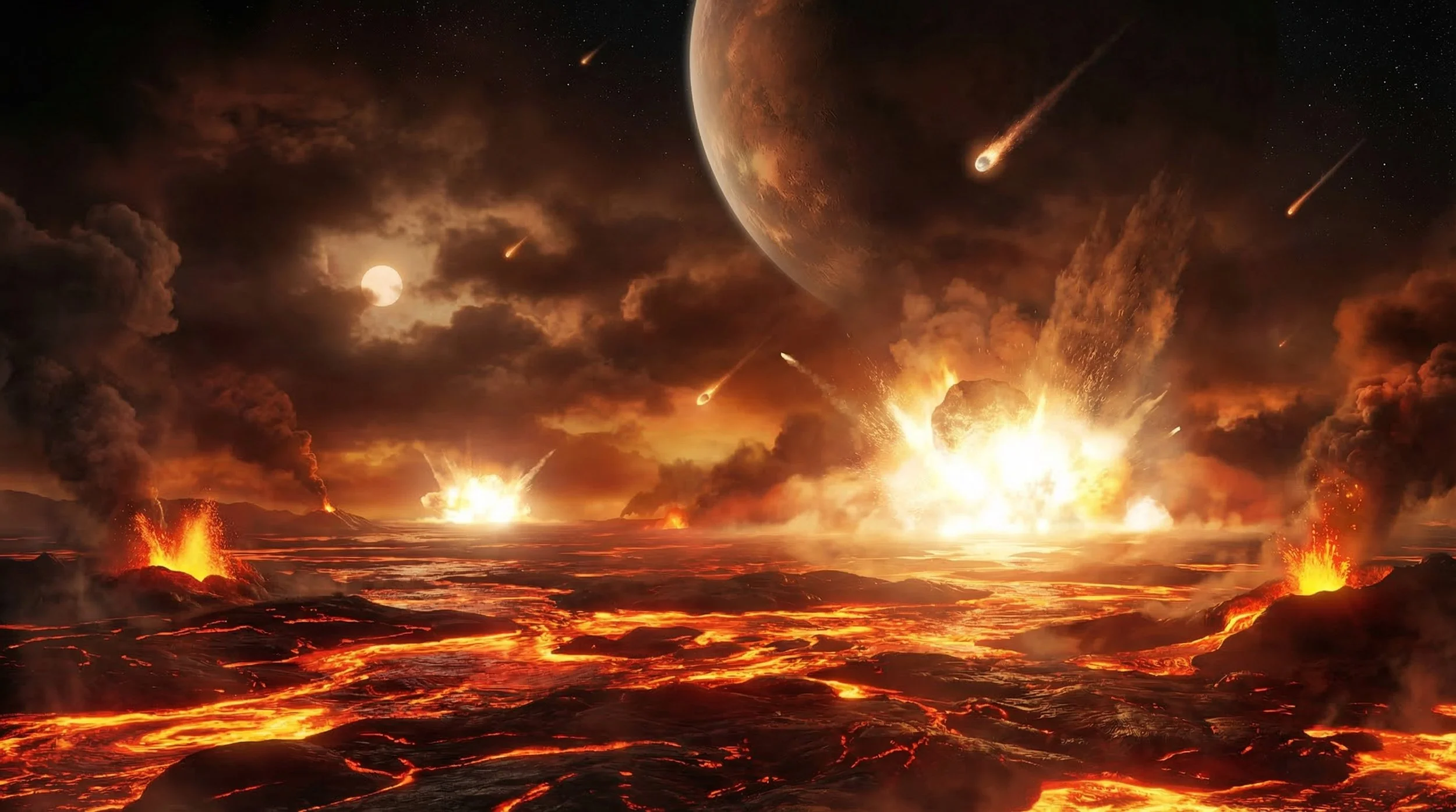
About 4.56 billion years ago, our solar system formed from a rotating disk of gas and dust. The earliest phase of Earth is called the Hadean Eon—named after Hades, the Greek god of the underworld. The young Earth was a hellish place: molten rock on the surface, constant asteroid impacts, temperatures exceeding a thousand degrees. A collision with a Mars-sized celestial body likely tore away enough material to form the Moon.
Gradually, the surface cooled. Volcanoes emitted gases that formed a primitive atmosphere. Water condensed to form the first oceans. The oldest evidence of liquid water—inclusions in zircon crystals from Western Australia—dates back about 4.4 billion years. There was no sign of glaciers in those early days.
The Archean: The Origin of Life (4.0–2.5 billion years ago)
Nano Banana Pro: A Promt by Jürg Kaufmann
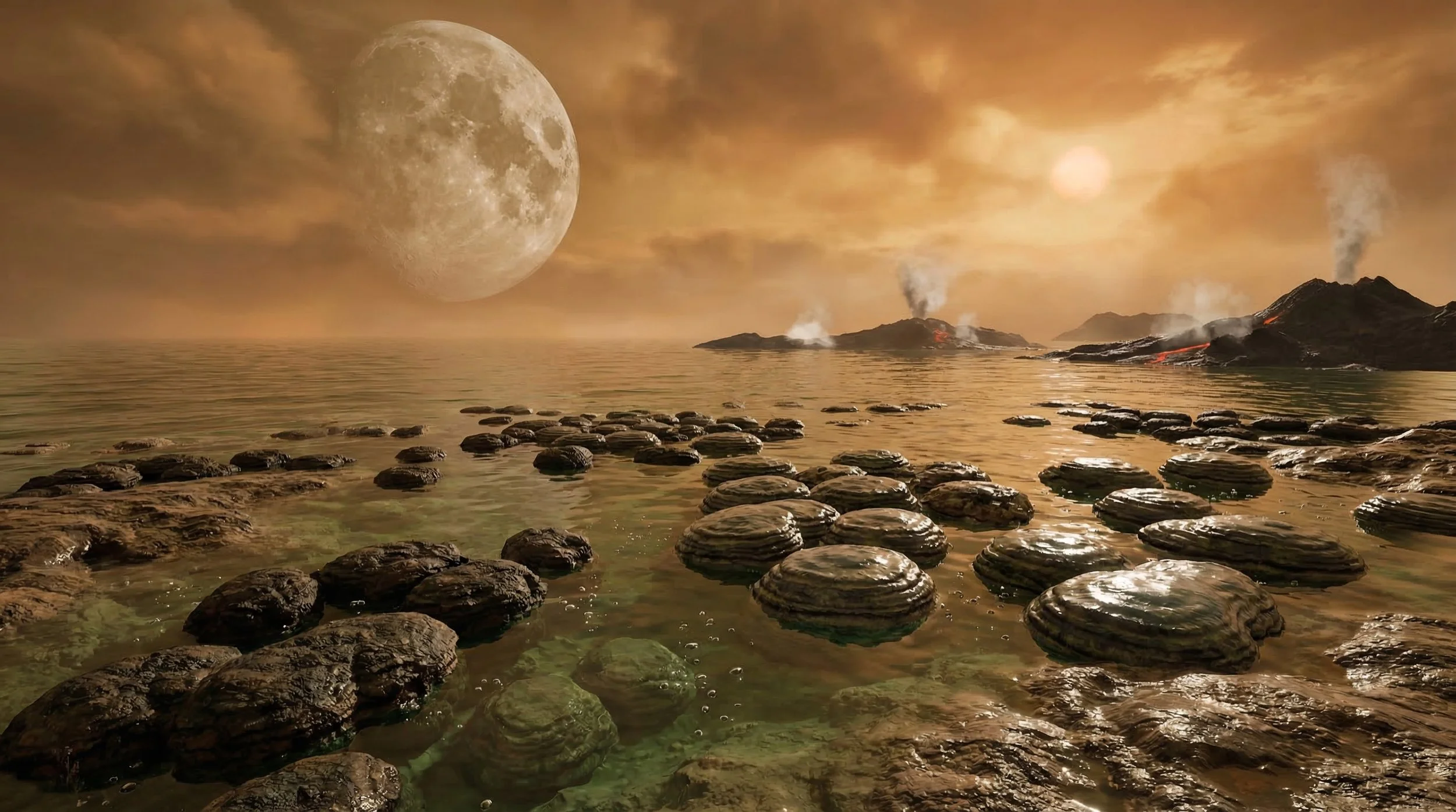
Small proto-continents floated on the denser Earth's mantle and were rearranged by plate tectonics. The atmosphere contained no free oxygen—it consisted mainly of nitrogen, methane, and water vapor.
The most significant development was the emergence of life. The oldest chemical traces are about 3.8 billion years old. The oldest fossils—stromatolites, layered structures formed by microbial mats—date back to about 3.5 billion years ago. Cyanobacteria began photosynthesis, a process that releases oxygen. The consequences would change the Earth forever—among other things, this oxygen made ice ages possible in the first place.
The Proterozoic: The First Ice Ages (2.5 billion to 541 million years ago)
Nano Banana Pro: A Promt by Jürg Kaufmann
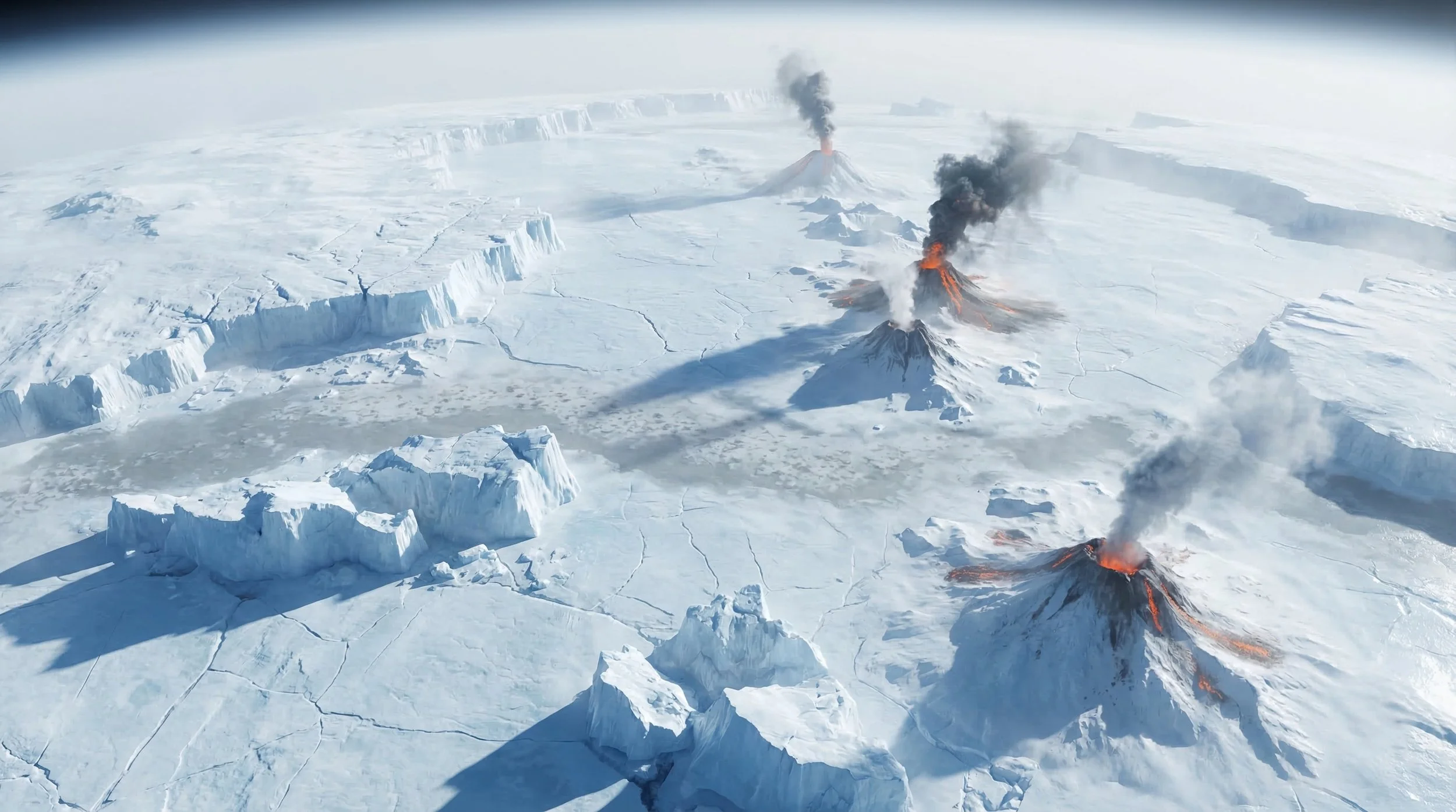
The Proterozoic Era spans nearly two billion years—about 42 percent of Earth’s history. It was during this period that some of the most dramatic upheavals in our planet’s history occurred.
The Huronian Glacial Period
About 2.4 to 2.1 billion years ago, Earth experienced its first documented major ice age. Cyanobacteria had slowly released oxygen into the atmosphere, which broke down the methane present—a powerful greenhouse gas. The result was a drastic reduction in the greenhouse effect and a massive cooling. For the first time, glaciers played a global role on Earth.
Snowball Earth – the Ice Ball
The most famous global glaciations occurred during the Cryogenian, the "ice-age era." Two episodes dominated: the Sturtian glaciation (approximately 717–660 million years ago, lasting 57 million years) and the Marinoan glaciation (approximately 645–635 million years ago). In both cases, glaciers reached the tropics—as evidenced by paleomagnetic measurements of rocks that once lay at the equator.
Evidence can be found in glacial striations on rock, tillites (fossilized glacial deposits), and dropstones—large boulders carried into the sea by icebergs. For the Sturt glaciation alone, such traces have been documented at 39 sites across six continents.
Whether the Earth was actually a complete "snowball" or more of a "slushball" with a strip of open water at the equator remains a subject of scientific debate. However, the extreme duration of the Sturtian glaciation suggests that the Earth was almost completely covered in ice.
The end came abruptly each time: over millions of years, volcanoes had accumulated gases beneath the ice sheet. Once a critical threshold was reached, the ice melted rapidly, followed by periods of extreme heat. Many researchers see a connection between the end of these ice ages and the emergence of complex life. The first large, visible organisms—the Ediacaran fauna—appeared shortly thereafter.
The Paleozoic Era: The Explosion of Life and Gondwana Ice (541–252 million years ago)
Nano Banana Pro: A Promt by Jürg Kaufmann
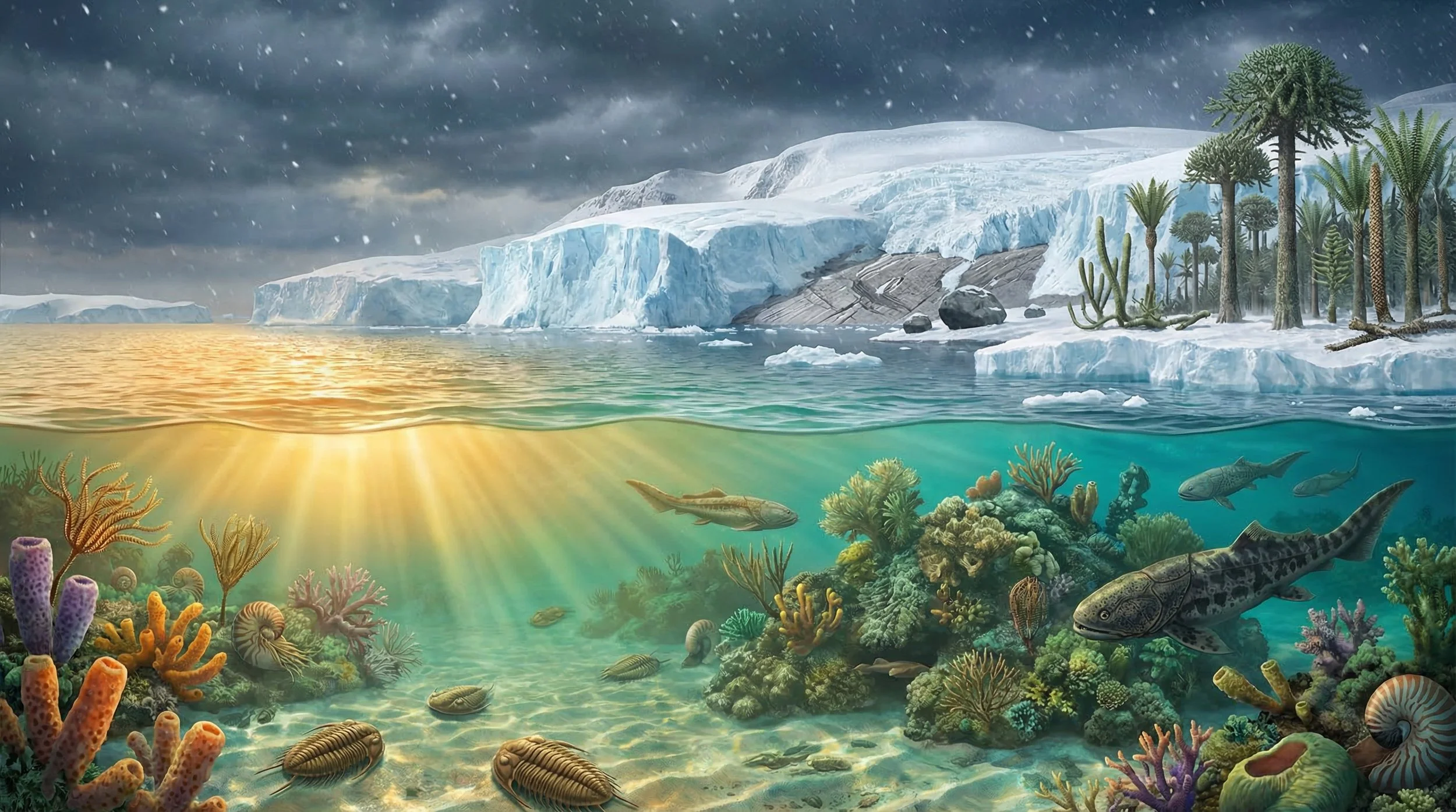
The Cambrian Explosion
About 541 million years ago, nearly all known animal phyla appeared in the fossil record within a few million years. Trilobites, sponges, and early vertebrate ancestors inhabited the oceans. The first land plants appeared in the Silurian period, and the first forests in the Devonian.
Ice Ages in the Paleozoic Era
During the late Ordovician and early Silurian periods (approximately 460–420 million years ago), Earth experienced the Andean-Saharan Glacial Period. Gondwana was located over the South Pole, and extensive ice sheets covered areas in what is now South America and the Sahara. This glaciation coincided with one of the five major mass extinctions.
This was followed by the largest ice age of the Phanerozoic: the Late Paleozoic Ice Age (approx. 360–260 million years ago). For a hundred million years, massive ice sheets grew and shrank on Gondwana—the southern part of the supercontinent Pangaea, which lay over the South Pole. Traces of these glaciers—tillites, eroded rock, and erratic boulders—can be found today on all southern continents and were among the early arguments supporting the theory of continental drift.
The end of the Paleozoic Era marked the largest mass extinction in Earth's history: 252 million years ago, up to 96 percent of all marine species disappeared, triggered by massive volcanic eruptions in Siberia.
The Mesozoic Era: A World Without Ice (252–66 million years ago)
Nano Banana Pro: A Promt by Jürg Kaufmann
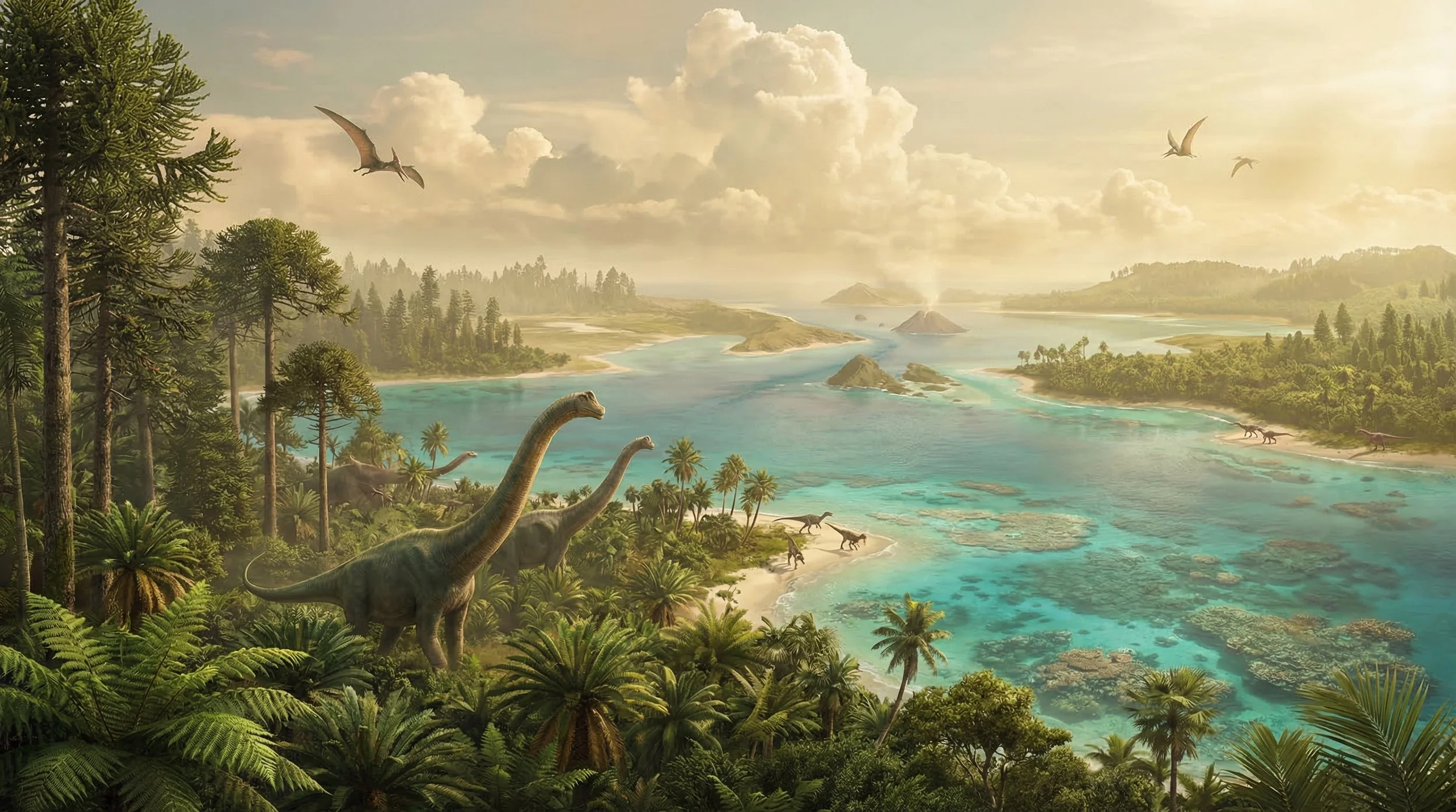
From a glaciological perspective, the age of the dinosaurs was remarkable: for nearly all of those 186 million years, the Earth was warm and virtually ice-free. There were no polar ice caps and no extensive glaciers. Fossils of subtropical plants have been found as far north as the Arctic Circle. Dinosaurs roamed Alaska and Antarctica.
Pangaea broke apart, the Atlantic Ocean formed, and India drifted northward. The Mesozoic Era ended 66 million years ago with the Chicxulub asteroid impact in Yucatán. About 75 percent of all species became extinct, including all dinosaurs except birds.
The Cenozoic Era: The Return of the Ice (66 million years ago to the present)
From warmth to cold
Nano Banana Pro: A Promt by Jürg Kaufmann
After the dinosaurs went extinct, mammals took over. The first few million years were still warm—in the early Eocene, there were palm forests in the Arctic. But then a long cooling period began. About 34 million years ago, the first ice sheet formed in Antarctica, aided by the opening of the Drake Passage and the uplift of the Himalayas.
For 34 million years, Earth has been in an ice age. This may come as a surprise: for most of its history, Earth was ice-free. Our present era is the exception.
The Pleistocene: The Great Ice Age Cycles
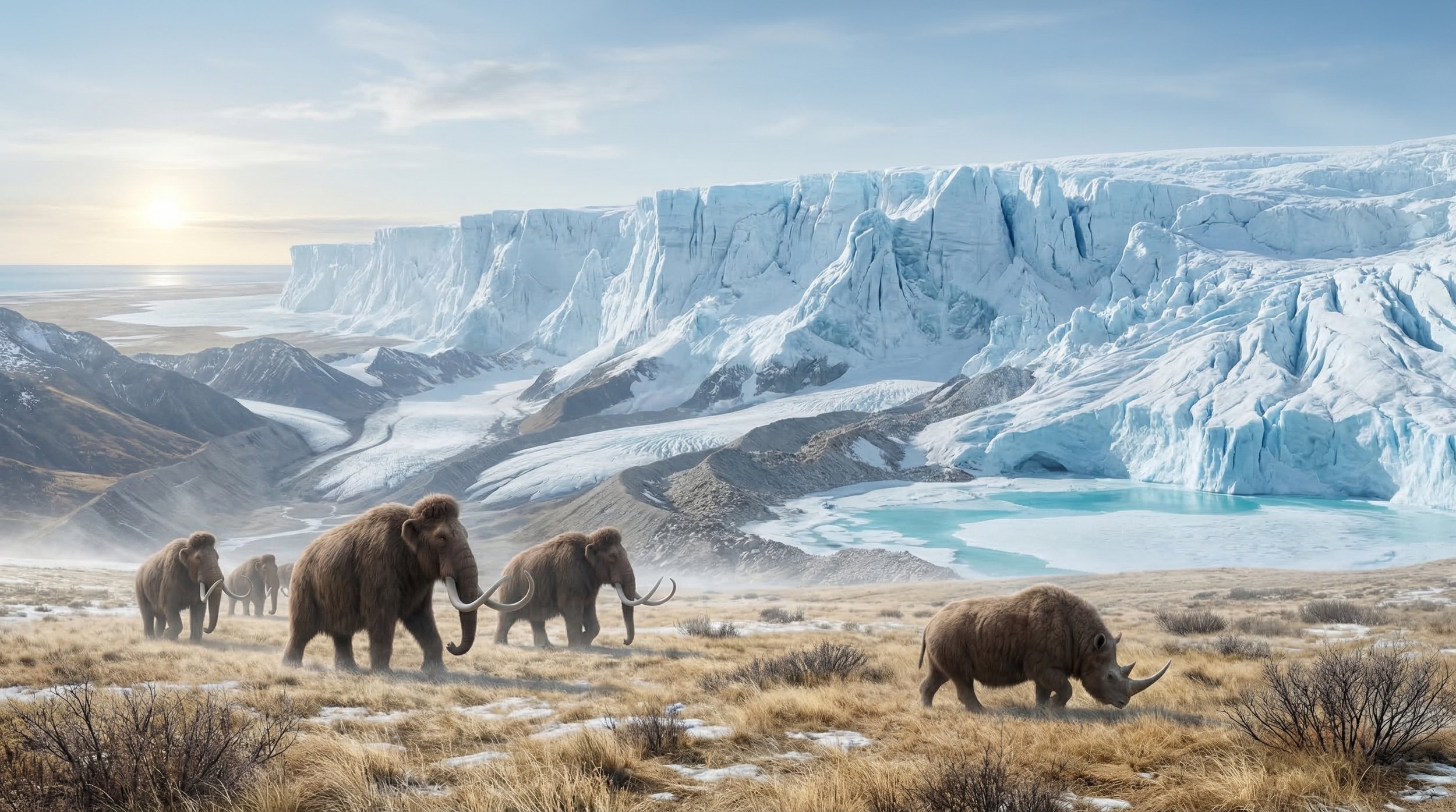
About 2.6 million years ago, the massive ice cycles of the Pleistocene began. Ice sheets up to four kilometers thick periodically covered large parts of North America and Europe. Cold and warm periods alternated—initially in 41,000-year cycles, later in 100,000-year cycles, driven by the Milanković cycles: regular fluctuations in the Earth’s orbit and axial tilt that determine how much solar radiation reaches the high latitudes.
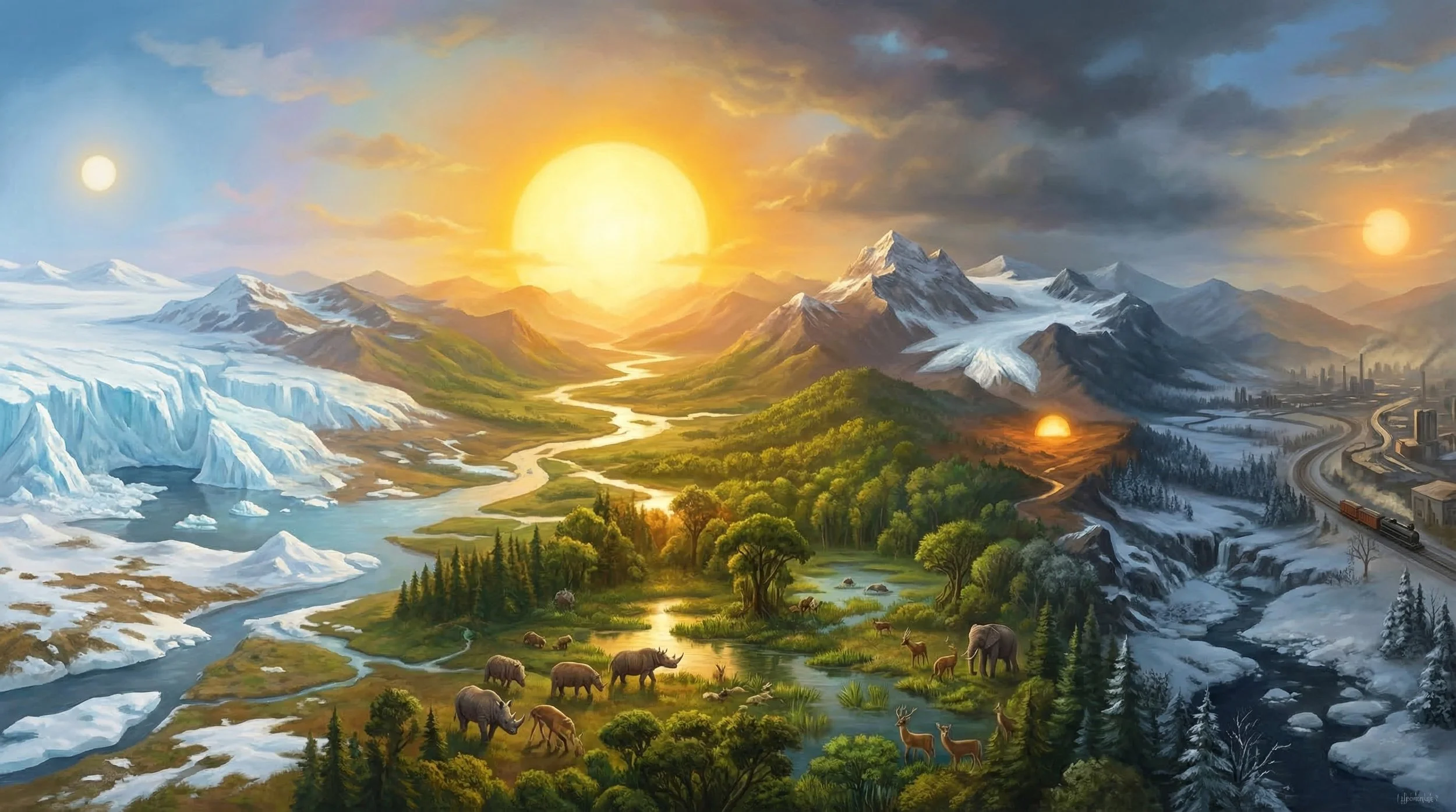
At the height of the last ice age, some 26,000 to 20,000 years ago, sea levels were 120 meters lower than they are today. Alpine glaciers extended as far as the Swiss Plateau, shaping the landscape—U-shaped valleys, moraines, and lakes. Mammoths and woolly rhinoceroses roamed the ice-age steppes.
The Holocene: Our Warm Period
Nano Banana Pro: A Promt by Jürg Kaufmann
The last major cold period ended 11,700 years ago. We are living in the Holocene—an interglacial period. The ice sheets of Antarctica and Greenland show that, in geological terms, the Ice Age is still ongoing. Today, glaciers cover about ten percent of the Earth’s land surface. Learn more about our warm period
The Future: How the Story Ends
The sun is gradually getting brighter—by about ten percent every billion years. In about a billion years, the oceans will evaporate. The Earth will become a hot, dry world. Glaciers will then be a thing of the past.
In about five billion years, the hydrogen in the Sun’s core will be exhausted. The Sun will swell into a red giant, a hundred times larger than it is today. Mercury and Venus will be engulfed. Recent computer simulations show that the Earth is unlikely to escape either: in about 7.6 billion years, the Sun will reach a radius that extends beyond Earth’s current orbit. Tidal forces will pull the Earth inward. Our planet will dissolve into the Sun’s glowing shell.
After that, a white dwarf will remain—an object about the size of Earth that will cool down over trillions of years. The solar system as we know it will have ceased to exist.
Epilogue
Nano Banana Pro: A Promt by Jürg Kaufmann
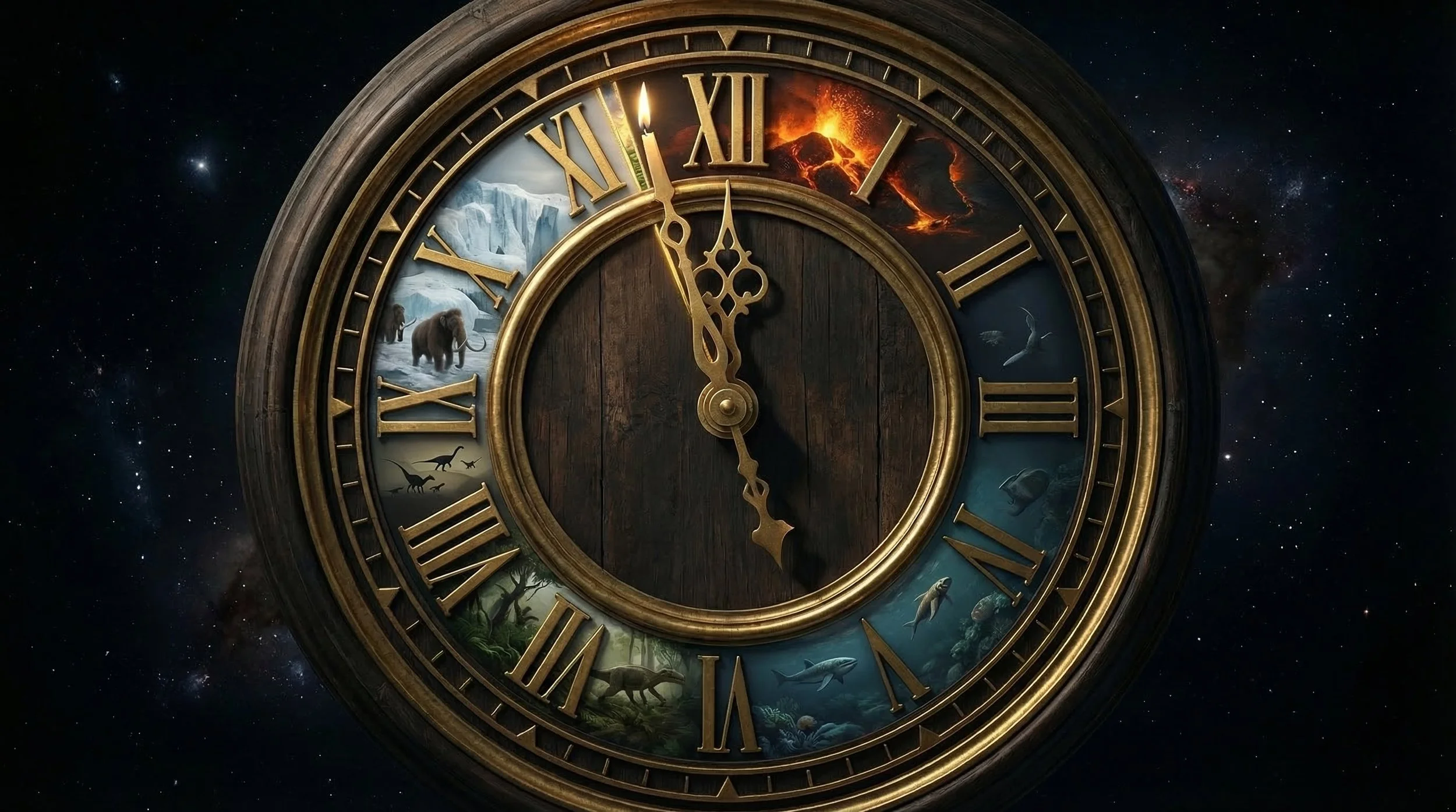
If we compress the 4.56 billion years of Earth’s history into a single day, the extent of our transience becomes tangible. The dinosaurs disappear at 11:39 p.m. The massive ice cycles of the Pleistocene—mammoths, kilometer-thick glaciers across Europe—don’t begin until just fifty seconds before midnight. The entire history of Homo sapiens unfolds in the last six seconds. And the Holocene, that warm period in which all civilizations arose—agriculture, writing, cities, industry, everything—begins one-fifth of a second before midnight.
Earth’s history shows that glaciers are not a given. For most of Earth’s history, the planet was ice-free. Today’s ice masses—from the Aletsch Glacier to the Antarctic Ice Sheet—are the exception. They exist because we are living in one of the rare ice ages.
At the same time, ice is a tremendous force. The Snowball Earth episodes brought life to the brink of extinction—and may have driven evolution forward. Pleistocene glaciers carved valleys, created lakes, and dispersed rock over thousands of kilometers. The history of Earth is not yet over. But the chapter in which glaciers play a role might be shorter than we think.
Sources
Age of the Universe: ESA's Planck Satellite – Planck 2018 Results (ESA)
The Big Bang and Cosmology: Harvard Center for Astrophysics – What happened in the early universe?
Geological Time Scale: International Commission on Stratigraphy (ICS) – International Chronostratigraphic Chart
Geological Time Scale (Overview): U.S. National Park Service – Geologic Time Scale
Snowball Earth: Hoffman, P.F. et al. (1998), A Neoproterozoic Snowball Earth, Science – Wikipedia: Snowball Earth
Snowball Earth (Research Interview): Paul Hoffman in Knowable Magazine – The Story of Snowball Earth
Duration of the Sturtian glaciation: Dutkiewicz, A. et al. (2024), Geology – University of Sydney
Slushball Hypothesis: NASA GISS – Snowball Earth Might Have Been Slushy
Late Paleozoic Ice Age: Wikipedia – Late Paleozoic Icehouse
The History of Earth's Ice Ages: Environmental Geology (Thompson Rivers University) – Glacial Periods in Earth's History
Quaternary glaciation: Wikipedia – Quaternary glaciation
Pleistocene Ice Ages and Milanković Cycles: Penn State Earth 103 – Ancient Climate Events: Pleistocene Glaciation
The Future of the Sun (Red Giant): NASA Exoplanet Science – Aging Into Gianthood
The Fate of Earth: Schröder & Smith (2008), Monthly Notices of the Royal Astronomical Society – Scientific American: The Sun Will Eventually Engulf Earth
Solar Brightness and Habitability: The Conversation – Why Do Humans Have Only 1 Billion Years Left on Earth?
