
When the Sahara reaches the Alps: How microscopic particles make glacier ice melt
I was out and about in the Bernina region in mid-March. There was a lot of Saharan dust in the air that day.
Luckily (or maybe not so lucky for photos!), the Saharan dust mostly stayed in the lower areas and was only a bit visible on the white surfaces. A few days later, it snowed again, so the dust's impact stayed pretty limited.
Saharan dust is one of those aerosols that really affect glaciers and our climate. When you picture Alpine glaciers, you probably think of ice, snow, and crisp mountain air, right? But something we can barely see with our own eyes has a huge, measurable impact on how fast our glaciers melt: tiny particles floating in the air, called aerosols. And Saharan dust is a big player among them.
This article breaks down the physics, sums up the most important research from recent years, and explains why this invisible threat is such a big deal for Alpine glaciers.
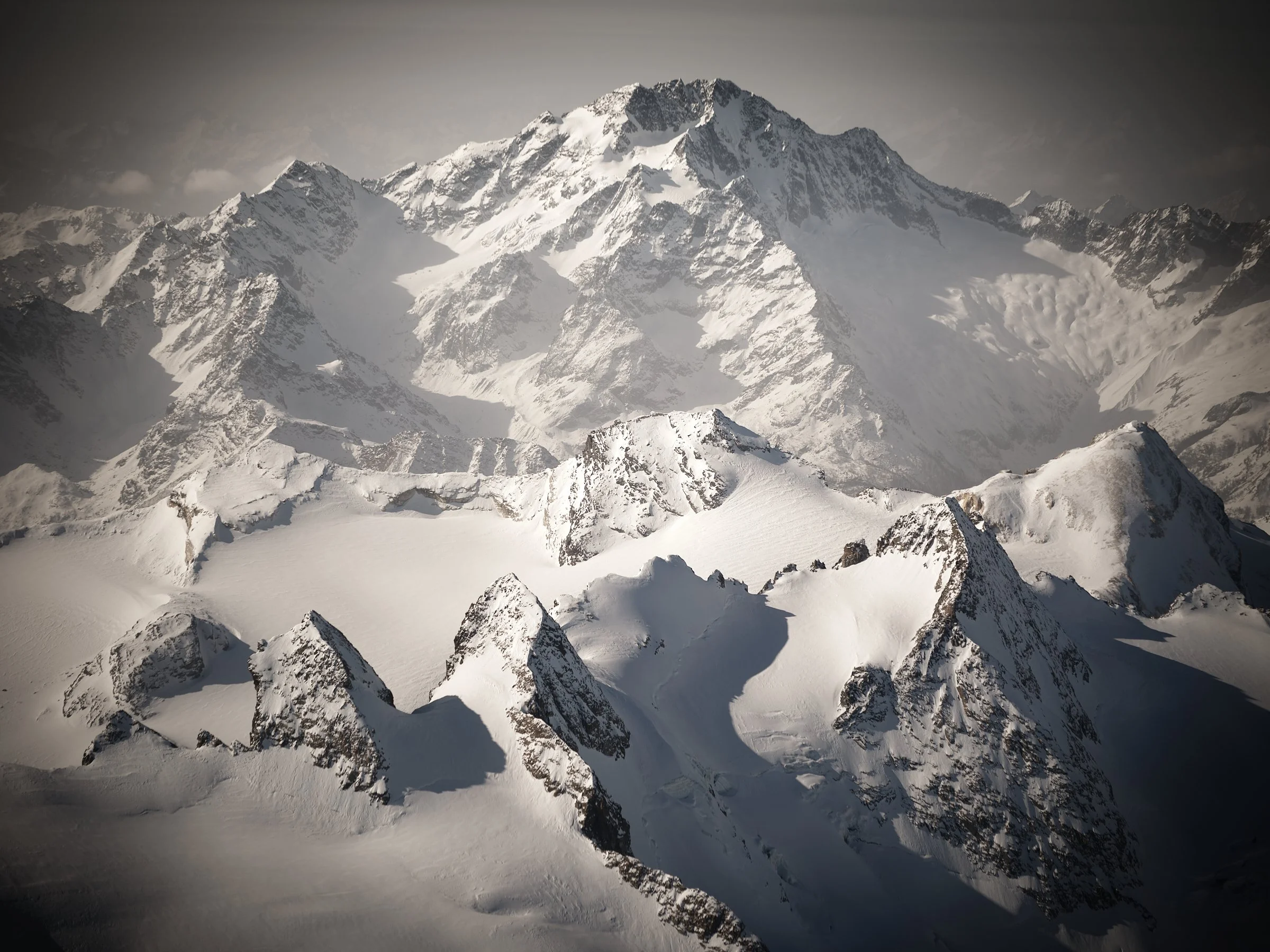
Mid-March 2026, Saharan dust making its way into the Bündner Alps through Italy. Photo ©Jürg Kaufmann
What are aerosols?
Aerosols are solid or liquid particles that float in the atmosphere. Their size ranges from a few nanometers to several dozen micrometers — for comparison, a human hair is about fifty times thicker than the largest aerosol particles. Despite their tiny size, they influence the climate in two fundamentally different ways: They scatter and absorb sunlight in the atmosphere, and they change the surface of snow and ice when they settle there.
The most important types of aerosols can be distinguished by their origin and their optical properties:
Aerosol types and their effect on sunlight
| Aerosol type | Main sources | Effect on sunlight |
|---|---|---|
| Sulfate | Industry, volcanoes (SO₂ oxidation) | Almost pure scattering — cools the atmosphere |
| Sea salt | Sea spray | Scattering — cools the atmosphere |
| Mineral dust | Deserts (especially Sahara), dry soils | Scattering and absorption — depending on iron content |
| Soot (Black Carbon) | Burning fossil fuels, wildfires | Strong absorption — warms the atmosphere |
| Organic aerosols | Biomass burning, vegetation | Mixed — depending on composition |
What research has measured
The following research findings come from peer-reviewed scientific studies based on direct physical measurements — not on model estimates or consensus statements. They show the extent of Saharan dust's impact on Alpine glaciers with concrete figures.
100 Years of Claridenfirn: The world's longest dataset
The most comprehensive long-term study was carried out by Gabbi and colleagues (2015) on the Claridenfirn in the Swiss Alps. There, a globally unique, century-long dataset of seasonal mass balance measurements exists, spanning from 1914 to 2014. The researchers reconstructed the historical deposition of mineral dust and soot using firn and ice cores, combining this data with a mass balance and snow layer model.
The results are clear: The presence of Saharan dust and soot reduced the average annual albedo by 0.04 to 0.06 — depending on the glacier's position. This led to an increase in annual melt by 15 to 19 percent compared to pure snow conditions. The average annual mass balance was reduced by 280 to 490 millimeters water equivalent.
A particularly important finding concerns what's called re-exposure: At the upper part of the glacier, where the mass balance was mostly positive, layers of contamination were continuously buried under fresh snow. At the lower part, however, where negative mass balances often occurred, old, dust- and soot-enriched layers reappeared on the surface — further intensifying the albedo reduction.
Summary of Measurement Data: Saharan Dust and Glacier Melt
| Study | Location | Period | Albedo reduction | Melt increase | Mass balance effect |
|---|---|---|---|---|---|
| Gabbi et al. (2015) | Claridenfirn, CH | 1914–2014 | −0.04 to −0.06 (annual average) | +15–19% annually | −280 to −490 mm w.e./year |
| Oerlemans et al. (2009) | Morteratsch, CH | 2003–2006 | 0.32 → 0.15 (summer) | +3.5 m ice in 4 years | Equivalent to +1.7°C |
| Roussel et al. (2025) | Argentière, FR | 2019–2022 | Not specified | +8–16% summer melt | −0.31 to −1.2 m w.e./year |
| Di Mauro et al. (2019) | Torgnon, IT | 2013–2016 | Not specified | Snow gone 11–38 days earlier | Not specified |
| Révéillet et al. (2022) | French Alps | 40 years | Not specified | Snow gone 17–20+ days earlier | Not specified |
| Di Mauro et al. (2024) | Presena, IT | 2020 | −35.3% (dust alone) | +203.7 W/m² radiative forcing | Not specified |
Vadret da Morteratsch: When dust has an impact as strong as 1.7°C warming
Oerlemans, Giesen, and Van Den Broeke (2009) found that the glacier tongue at Vadret da Morteratsch in Switzerland got dramatically darker. Since 2003, a buildup of mineral and biogenic dust made the summer surface albedo drop from 0.32 to 0.15 — that's more than half! From 2003 to 2006, this darker surface caused an extra ice loss of about 3.5 meters.
To help us understand this better, the researchers figured out how much the temperature would need to rise to cause the same amount of melting just from warming. The answer? 1.7°C. So, dust making the glacier surface darker has the same impact on melting as if it got almost two degrees Celsius warmer!
The study also found a key feedback loop: As the glacier shrinks, it uncovers side moraines and rock debris. Wind then carries this local mineral dust onto the glacier's surface, which encourages algae to grow, makes the surface even darker, and speeds up melting — it's a cycle that just keeps getting stronger!
Argentière Glacier: The Extreme Year 2022
Roussel and their team (2025) looked at how much Saharan dust affected the Argentière Glacier's surface mass balance in the French Alps from 2019 to 2022. In the three years before 2022, mineral dust contributed to an annual decrease of between 0.31 and 0.45 meters water equivalent. But in the super-melting year of 2022, this contribution actually doubled to 0.63 meters water equivalent (that's the median), and in some spots on the glacier, it even hit 1.2 meters!
All in all, dust was responsible for 8 to 16 percent of the Argentière Glacier's total summer melt, varying each year. The impact wasn't spread evenly; it was strongest where older firn layers got exposed after all the winter snow had completely melted away.
Torgnon: When the Snow Disappears 38 Days Earlier
Di Mauro and their team (2019) checked out how Saharan dust events affected snowmelt at a high-up spot (2160 m) in Italy's Aosta Valley over three years. During the 2015/2016 season, which had a really strong Saharan dust event, the snow vanished 38 days sooner than it would have without the dust — and that was in a total snow season of just seven months! In the 2013/2014 and 2014/2015 seasons, the snow disappeared early by 18 and 11 days, respectively.
A geochemical analysis of the dust in the snow confirmed it came from the Sahara, especially because it had a lot of iron. The researchers also came up with something called the Snow Darkening Index (SDI), which lets them keep an eye on how much dust is on the snow just by using digital photos.
40 Years of French Alps: Large-Scale Evidence
Réveillet and their team (2022) ran a 40-year computer simulation across all the French Alps and Pyrenees. What they found was that soot and dust deposits have, on average, made the snow season end 17 days earlier. And up at 3000 meters, the snow even disappeared more than 20 days sooner!
Here's something interesting: the impact of dust gets stronger with altitude more than soot does. It's all about physics! Big Saharan dust events usually happen after March, which is when shortwave solar radiation is already super intense at high altitudes. Down lower, the snow often starts melting earlier, so the dust doesn't have as much of an effect there.
Biological Amplifier: Combined Effect of Algae and Dust
| Impurities | Broadband albedo reduction | Radiative forcing |
|---|---|---|
| Snow algae alone | 7.4 ± 6.1% | 42.3 ± 36.1 W/m² |
| Mineral dust alone | 35.3 ± 7.4% | 203.7 ± 45.5 W/m² |
| Combined (algae + dust) | 40.8 ± 8.4% | 211.8 ± 45.9 W/m² |
Source: Di Mauro et al. (2024), Presena Glacier, Rhaetian Alps. Measurements from July 7, 2020.
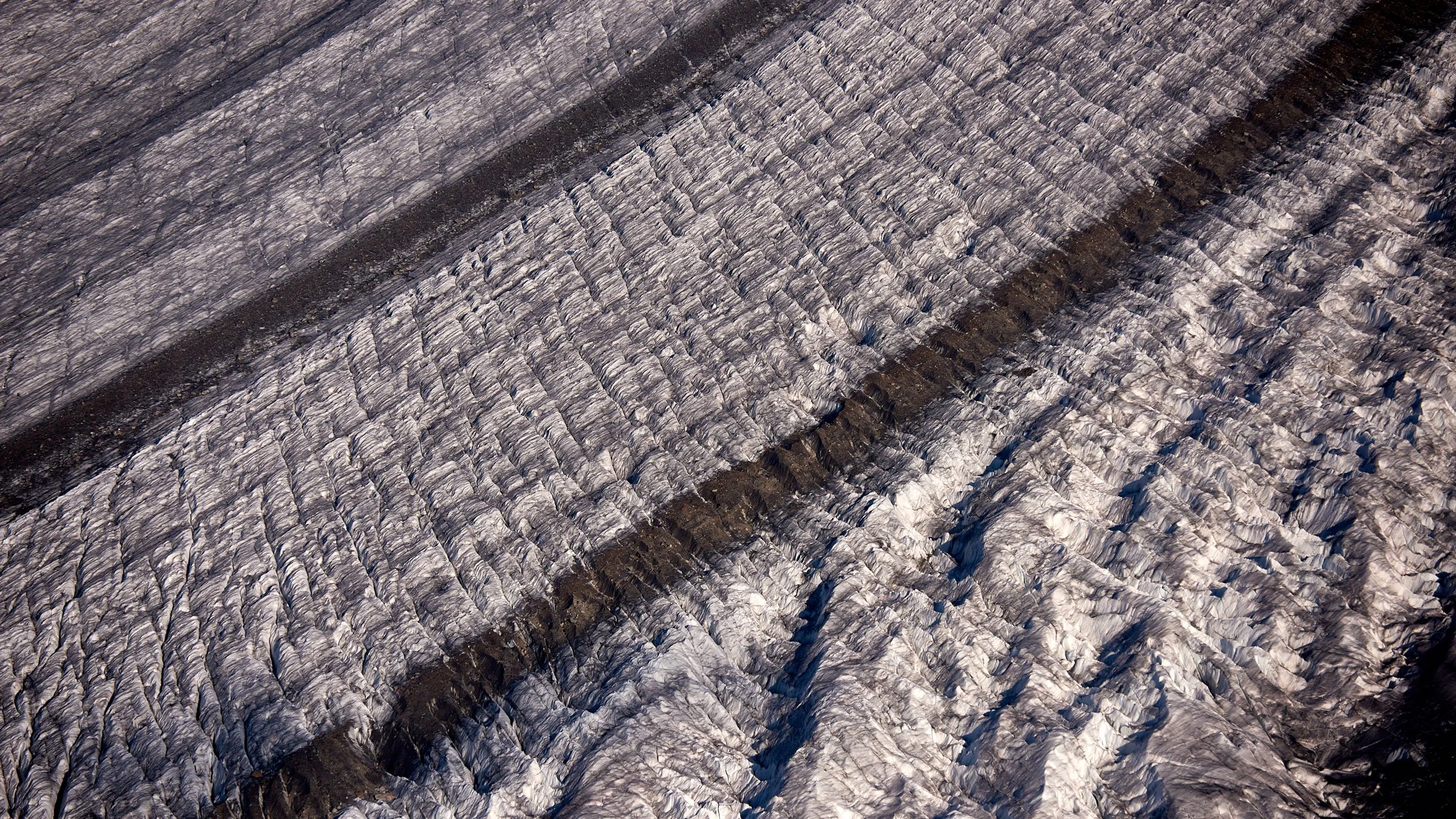
Deposits on the Great Aletsch Glacier. Photo © Jürg Kaufmann
The GLAMOS estimate for 2024 (10–20% more melt):
The Great Aletsch Glacier is currently losing about 1–1.5 m w.e. in mass balance per year. An increase of 10–20% due to Saharan dust means:
Across the entire glacier (~78 km²), that would be roughly 5–15 billion liters of additional meltwater per year, caused solely by Saharan dust deposits.
In summary: Saharan dust costs the Great Aletsch Glacier an estimated 15–20 cm of additional ice thickness annually on average across its entire area — and up to almost 1 meter extra at the particularly exposed glacier tongue.
