
Milanković Cycles and Glaciers
How Earth's orbit determines the fate of glaciers
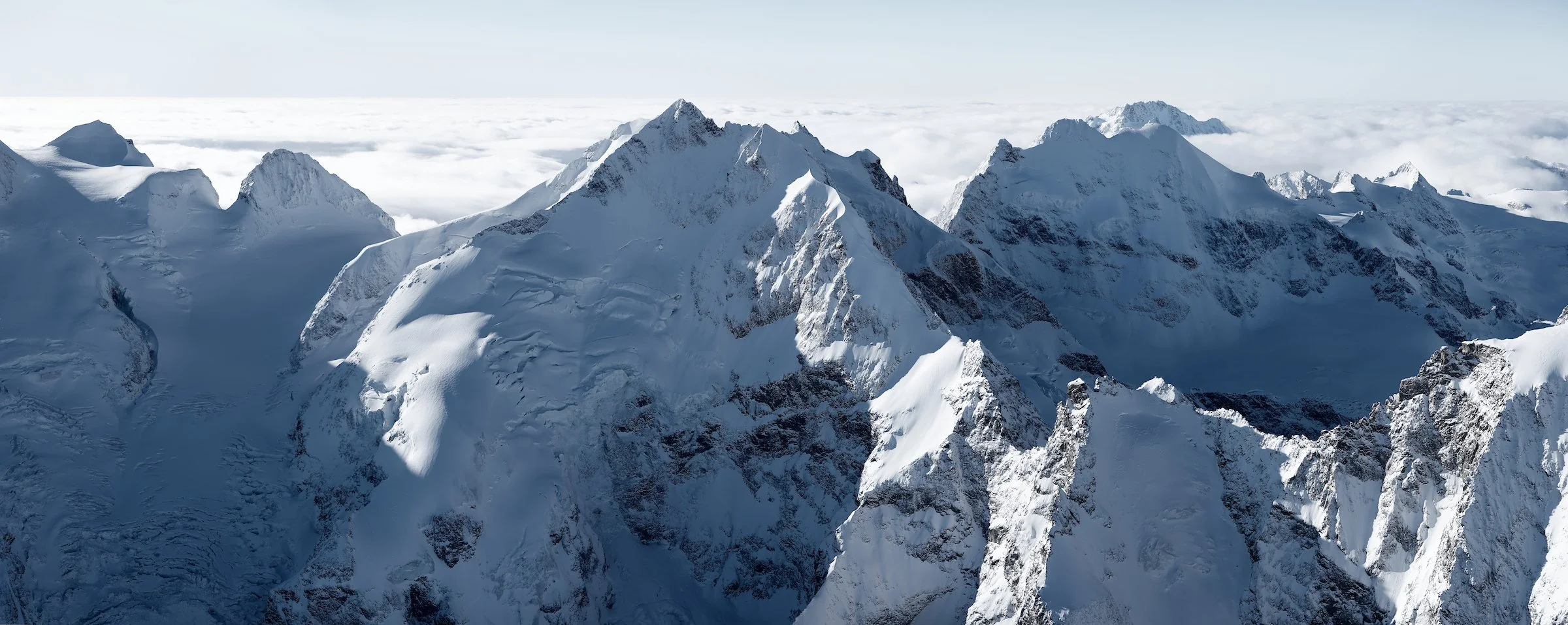
Bernina Massif with Bincograt Photo by Jürg Kaufmann
The Cosmic Clock of Our Ice Ages
About a century ago, the Serbian mathematician and geophysicist Milutin Milanković proposed a groundbreaking theory: Earth's long-term climate fluctuations – the rhythmic coming and going of ice ages – are largely controlled by periodic changes in Earth's orbit and axial tilt.
These fluctuations, known as Milanković Cycles, don't change the total amount of solar energy reaching our planet, but rather its distribution across seasons and latitudes. This very redistribution determines whether glaciers grow or shrink.
“Milanković Cycles cause fluctuations of up to 25 percent in the amount of incoming solar radiation at Earth's mid-latitudes.”
Three different orbital parameters work together, each with its own rhythm spanning tens to hundreds of thousands of years. Together, they form a complex pattern that drives our planet's climate history like a cosmic clockwork.
The Three Earth Orbital Parameters
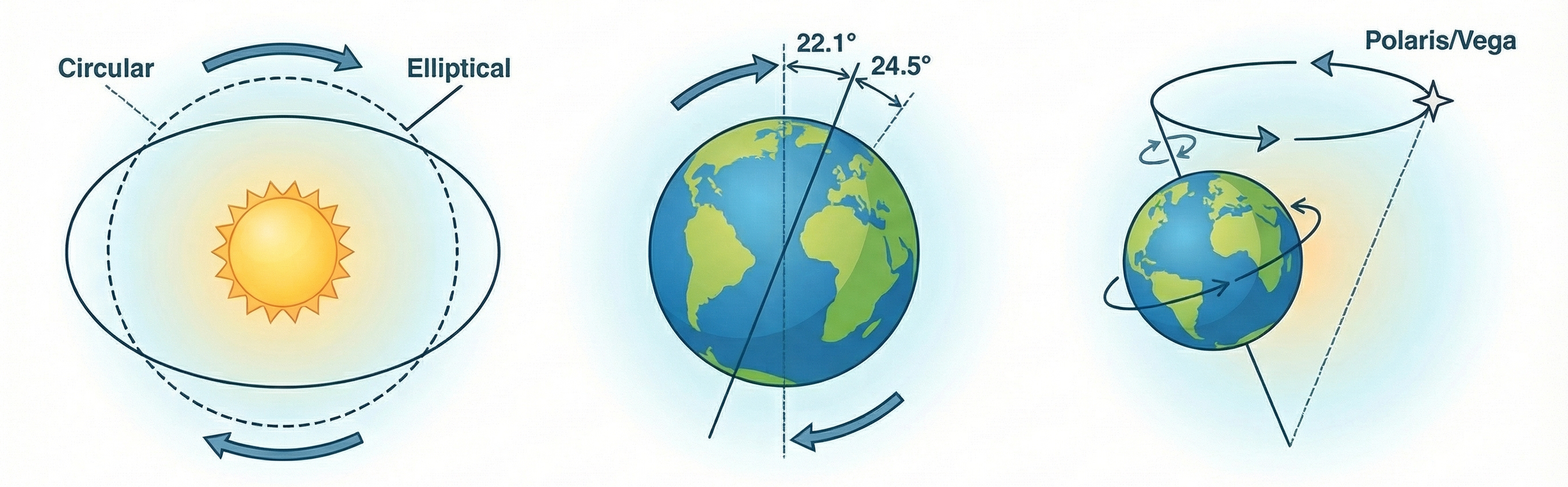
| Cycle | Mechanism | Periodicity | Current Status |
|---|---|---|---|
| Eccentricity | Change in Earth's orbital shape | ~100,000 & ~413,000 years | Decreasing (more circular) |
| Obliquity | Earth's axial tilt (22.1°–24.5°) | ~41,000 years | Decreasing (currently 23.4°) |
| Precession | Wobble of Earth's axis + Rotation of the ellipse | ~23,000 years | Perihelion in Northern Winter |
Eccentricity (Eccentricity)
Cycle: ~100,000 & ~413,000 years
The Earth's orbit shape varies between almost circular and slightly elliptical. This change is mainly caused by the gravitational forces of Jupiter and Saturn.
Impact on Glaciers:
With high eccentricity, up to 23% more solar radiation reaches Earth at its closest point to the sun. Eccentricity modulates the strength of precession and affects seasonal differences.
Current Status: Decreasing – the Earth's orbit is becoming more circular.
Obliquity
Cycle: ~41,000 years
The tilt of Earth's axis varies between 22.1° and 24.5° relative to its orbital plane. This tilt is why Earth has seasons.
Impact on Glaciers:
A greater tilt means more extreme seasons: hotter summers and colder winters. A smaller tilt favors cooler summers, allowing snow to survive and glaciers to grow.
Current Status:
Decreasing – currently 23.4° (middle of the range).
Precession
Cycle: ~23,000 years (combined)
Earth's axis 'wobbles' like a spinning top, and at the same time, the entire ellipse of Earth's orbit rotates. Together, they determine which season Earth is closest to the sun.
Impact on Glaciers:
It determines whether summer or winter in the Northern Hemisphere falls during the period of closest proximity to the sun. Currently, Earth is closest in January – in about 13,000 years, it will be in July.
Current Status: Perihelion (closest to the sun) in Northern Hemisphere winter (January).
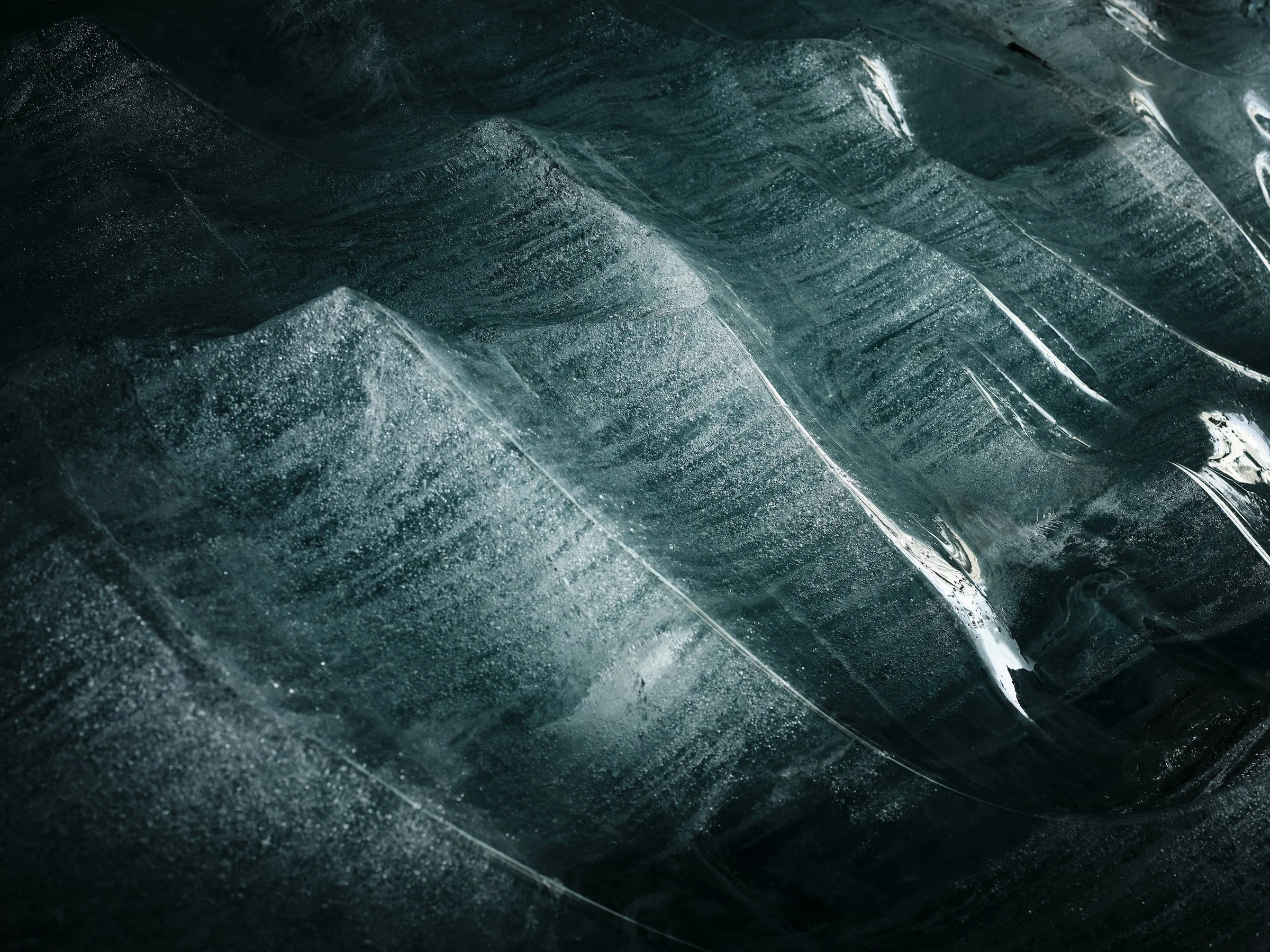
Basal Layers
Basal layers preserve climate information over thousands of years.
More about this:
Hidden Time - What Glacier Ice Tells Us
The last 11,700 years: Milanković Cycles in the Holocene

Graphic by Julien Seguinot: more about his work
Early Holocene (~10,000 – 6,000 BP) — Holocene Climatic Optimum
The Northern Hemisphere was closest to the sun in summer (perihelion in June/July). Summer insolation reached its maximum. Alpine glaciers were significantly smaller than today – many had almost completely disappeared for periods. The tree line was much higher than it is now.
Middle Holocene (~6,000 – 3,000 BP) — Start of Neoglaciation
Due to precession, the perihelion gradually shifted into the Northern Hemisphere winter. Summer insolation steadily decreased. Glaciers in the Alps began to grow again and repeatedly reached high stands comparable to those of the Little Ice Age.
Late Holocene (~3,000 BP – 1850 AD) — Neoglacial High Stands & Little Ice Age
The long-term trend of cooler summers continued. Alpine glaciers reached their greatest extent since the end of the last Ice Age during the Little Ice Age (approx. 1300–1850). The glaciated area in the Alps was almost 4,500 km² at that time.
The Present (1850 – Today) — Rapid Retreat
Since the end of the Little Ice Age, the glaciated area in the Alps has shrunk by half, down to about 2,250 km² (as of 2000). This retreat has sped up since the 1980s, with glaciers sometimes losing tens of meters in length each year. You can learn more about this in the GLAMOS project by ETH Zurich.
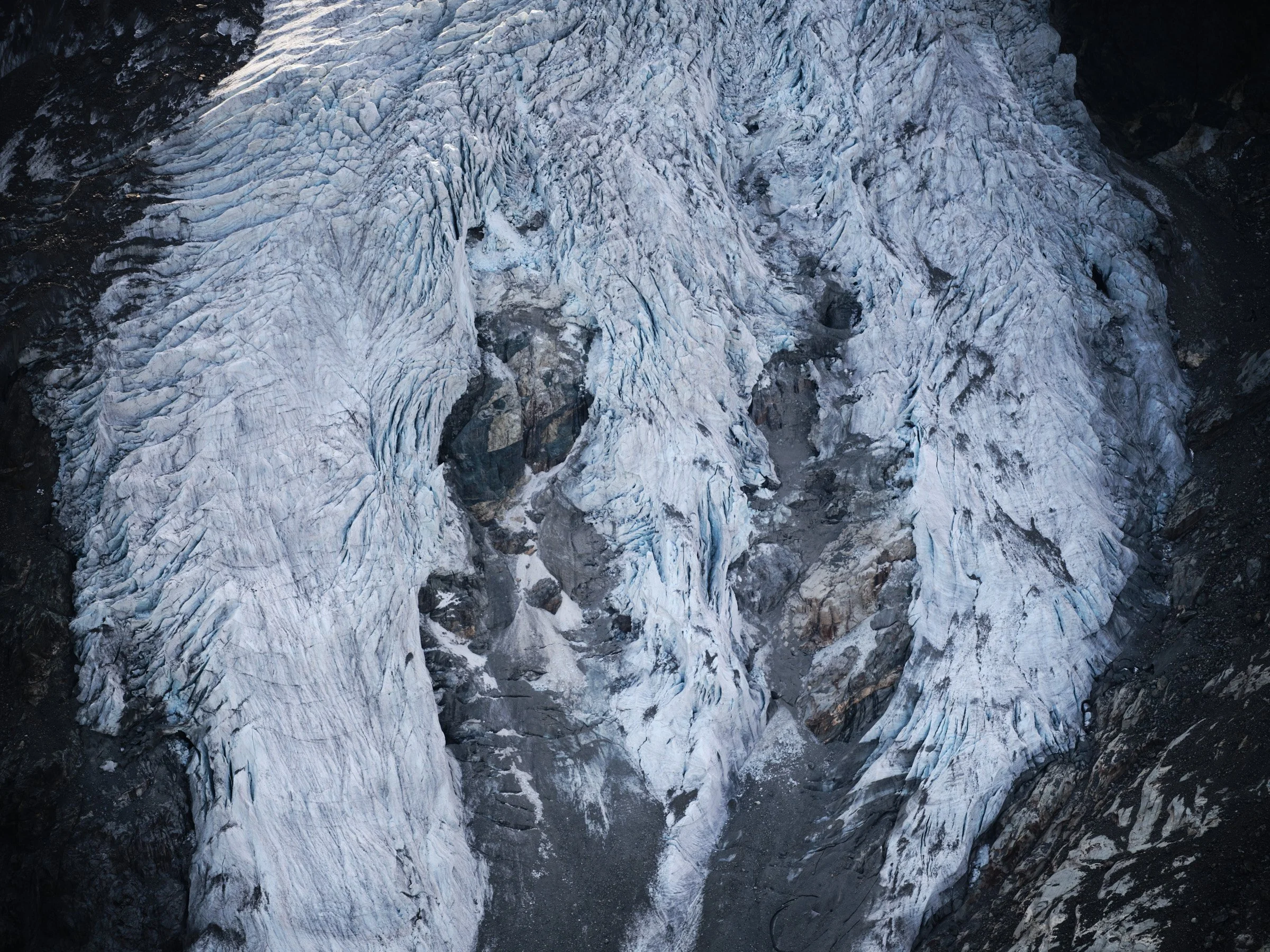
Thschierva Glacier: Photo by Jürg Kaufmann
Milanković Cycles vs. Solar Cycles
While solar cycles like the Schwabe cycle (11 years) or the Gleissberg cycle (70–100 years) show us short-term changes in the sun's intensity, Milanković cycles alter how the sun's energy is distributed geometrically over thousands of years.

Solar storm in May 2024: More about solar cycles
Solar cycles
They actually change the 'light bulb' itself – the sun's total power output varies over the 11-year Schwabe cycle.
- Schwabe Cycle: ~11 years
- Gleissberg Cycle: ~70–100 years
- Hallstatt Cycle: ~2,300 years
- Influence: Subtle, modulates regional climate patterns
*Metaphor: The brightness of the lamp changes slightly.*
Milanković Cycles
They change the 'distance and angle' to the light bulb – meaning the seasonal and geographical distribution of energy shifts dramatically.
- Precession: ~23,000 years
- Obliquity: ~41,000 years
- Eccentricity: ~100,000 & ~413,000 years
- Influence: Up to 25% variation in insolation at mid-latitudes
Metaphor: The lamp's position and tilt change fundamentally.
How They Work Together
Both systems are at play simultaneously, but they work on totally different timescales. Solar cycles tweak the climate over years to centuries, while Milanković cycles lay out the big picture over thousands to millions of years. The article we've already published on glaciers.today about solar cycles covers the short-term ups and downs – think of Milanković cycles as the long-term foundation underneath it all.
Where Are We Today?

Bernina Region with Pers Glacier from Piz Trovat. Photo Jürg Kaufmann
From a purely astronomical point of view, we've actually been in a long-term cooling trend for about 6,000 years. Summer sunlight in the Northern Hemisphere is slowly decreasing because the Earth's closest point to the sun (perihelion) has shifted from our summer to our winter. If nothing else were at play, the Alpine glaciers would be slowly but surely growing.
Astronomical Outlook
| Parameter | Trend |
|---|---|
| Obliquity | Decreasing – Minimum in ~10,000 years |
| Eccentricity | Decreasing – Orbit becoming more circular |
| Precession | Perihelion continues to shift into the Northern winter |
| Next Ice Age | Estimated in ~10,000 years |
As a photographer who's been capturing Alpine glaciers for decades, I've noticed a rapid retreat that goes against the long-term astronomical trend. The Milanković cycles give us the big picture, reminding us that Earth's climate follows a cosmic rhythm that stretches far beyond human timescales.
Understanding these cycles helps us put the current situation into perspective: astronomically speaking, glaciers should be slowly growing, so their shrinking instead definitely deserves our attention.
This article is part of the 'Insights' section on glaciers.today and provides factual information about natural climate factors. The scientific findings presented are based on peer-reviewed research.
